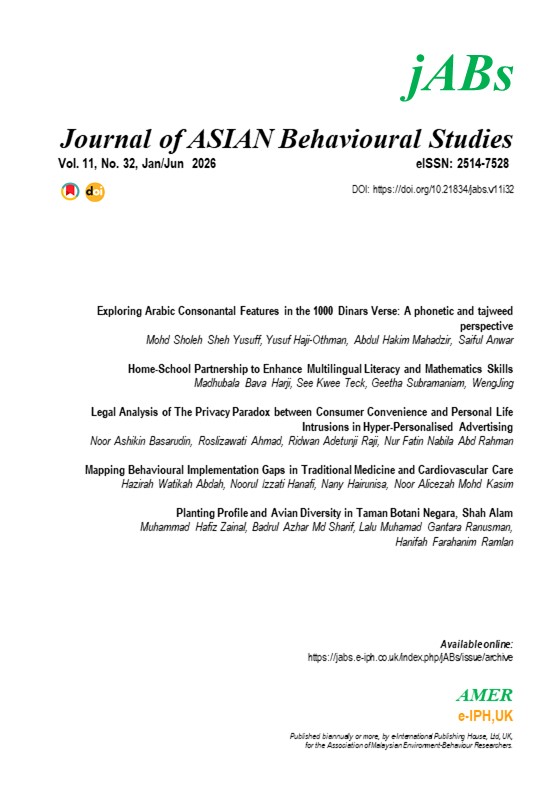
Legal Analysis of The Privacy Paradox between Consumer Convenience and Personal Life Intrusions in Hyper-Personalised Advertising
DOI:
https://doi.org/10.21834/jabs.v11i32.487Keywords:
Hyper-Personalised Advertising;, Algorithmic Targeting;, Personal Data Profiling;, Data ProtectionAbstract
This paper examines the privacy paradox in hyper-personalised advertising, where consumers enjoy increased convenience while unknowingly exposing themselves to deeper personal data intrusions. Driven by extensive algorithmic profiling, hyper-personalisation raises concerns of covert surveillance, behavioural manipulation, and diminished autonomy. Using a doctrinal legal method, the study analyses the Malaysian Personal Data Protection Act 2010 in comparison with the EU GDPR. The findings reveal significant regulatory gaps in transparency, consent validity, and accountability for profiling practices. The paper concludes that stronger legal safeguards and clearer ethical obligations for data controllers are essential to balance consumer convenience with meaningful privacy protection.
References
Alavi, S., Iyer, P., & Bright, L. F. (2024). Advertisement avoidance and algorithmic media: The role of social media fatigue, algorithmic literacy and privacy concerns. Journal of Digital & Social Media Marketing, 12(3), 276-292.
Alhabash, S., Mundel, J., & Hussain, S. A. (2017). Social media advertising: Unraveling the mystery box. In Digital advertising (pp. 285-299). Routledge.
Al-Hadrawi, B. K., & Jawad, A. R. (2024). Cognitive marketing and strategic drift: an exploration of cognitive bias in marketing decision-making. International Journal of Multidisciplinary Research and Growth Evaluation, 5(1), 933-946.
Barari, M., Casper Ferm, L. E., Quach, S., Thaichon, P., & Ngo, L. (2024). The dark side of artificial intelligence in marketing: meta-analytics review. Marketing Intelligence & Planning, 42(7), 1234-1256.
Barbu, O. (2014). Advertising, microtargeting and social media. Procedia-Social and Behavioral Sciences, 163, 44-49.
Barth, S., & De Jong, M. D. (2017). The privacy paradox–Investigating discrepancies between expressed privacy concerns and actual online behavior–A systematic literature review. Telematics and informatics, 34(7), 1038-1058.
Basarudin, N. A., Yeon, A. L., & Yusoff, Z. M. (2022). The role of cybersecurity law for sustainability of innovative smart homes (Goal 9). In Good Governance and the Sustainable Development Goals in Southeast Asia (pp. 110-117). Routledge.
Batista, M., Fernandes, A., Ribeiro, L. P., Alturas, B., & Costa, C. P. (2020, June). Tensions between privacy and targeted advertising: Is the general data protection regulation being violated?. In 2020 15th Iberian Conference on Information Systems and Technologies (CISTI) (pp. 1-5). IEEE.
Beauvisage, T., Beuscart, J. S., Coavoux, S., & Mellet, K. (2024). How online advertising targets consumers: The uses of categories and algorithmic tools by audience planners. New Media & Society, 26(10), 6098-6119.
Blass, J. (2019). Algorithmic advertising discrimination. Nw. UL Rev., 114, 415.
Bol, N., Dienlin, T., Kruikemeier, S., Sax, M., Boerman, S. C., Strycharz, J., ... & De Vreese, C. H. (2018). Understanding the effects of personalization as a privacy calculus: Analyzing self-disclosure across health, news, and commerce contexts. Journal of Computer-Mediated Communication, 23(6), 370-388.
Bozdag, E. (2013). Bias in algorithmic filtering and personalization. Ethics and information technology, 15(3), 209-227.
Cabañas, J. G., Cuevas, Á., & Cuevas, R. (2018). Unveiling and quantifying facebook exploitation of sensitive personal data for advertising purposes. In 27th USENIX Security Symposium (USENIX Security 18) (pp. 479-495).
Campbell, C., Sands, S., Ferraro, C., Tsao, H. Y. J., & Mavrommatis, A. (2020). From data to action: How marketers can leverage AI. Business Horizons, 63(2), 227-243.
Chan-Olmsted, S. M. (2019). A review of artificial intelligence adoptions in the media industry. International Journal on Media Management, 21(3-4), 193-215.
Davenport, T., Guha, A., Grewal, D., & Bressgott, T. (2020). How artificial intelligence will change the future of marketing. Journal of the Academy of Marketing Science, 48(1), 24-42.
De Hert, P., & Czerniawski, M. (2016). Expanding the European data protection scope beyond territory: Article 3 of the General Data Protection Regulation in its wider context. International Data Privacy Law, 6(3), 230-243.
De, S. J., & Imine, A. (2020). Consent for targeted advertising: the case of Facebook. AI & SOCIETY, 35(4), 1055-1064.
Eslami, M., Krishna Kumaran, S. R., Sandvig, C., & Karahalios, K. (2018, April). Communicating algorithmic process in online behavioral advertising. In Proceedings of the 2018 CHI conference on human factors in computing systems (pp. 1-13).
Faggella, D. (2018). AI in the life sciences: six applications. Genetic Engineering & Biotechnology News, 38(9), 10-11.
Femi-Adeyinka, C., Kose, N. A., Akinsowon, T., & Varol, C. (2024, April). Digital forensics analysis of youtube, instagram, and tiktok on android devices: A comparative study. In 2024 12th International Symposium on Digital Forensics and Security (ISDFS) (pp. 1-6). IEEE.
Gallery, C. (2024). Marketing to the hyper-connected consumer. In Fashion Business and Digital Transformation (pp. 143-177). Routledge.
Goldfarb, A. (2014). What is different about online advertising?. Review of Industrial Organization, 44(2), 115-129.
Guo, B., & Jiang, Z. B. (2025). Influence of personalised advertising copy on consumer engagement: a field experiment approach. Electronic Commercial Research, 25, 1281–1310.
Hazelwood, K., Bird, S., Brooks, D., Chintala, S., Diril, U., Dzhulgakov, D., ... & Wang, X. (2018, February). Applied machine learning at facebook: A datacenter infrastructure perspective. In 2018 IEEE International Symposium on High Performance Computer Architecture (HPCA) (pp. 620-629). IEEE.
Kant, T. (2021). Identity, Advertising, and Algorithmic Targeting: Or How (Not) to Target Your “Ideal User”.
Kietzmann, J., Lee, L. W., McCarthy, I. P., & Kietzmann, T. C. (2020). Deepfakes: Trick or treat?. Business Horizons, 63(2), 135-146.
Kim, H. Y. (2024). What’s wrong with relying on targeted advertising? Targeting the business model of social media platforms. Critical Review of International Social and Political Philosophy, 1-21.
Kohli, R., Gupta, S., & Gaur, M. S. (2025). Guarding Digital Privacy: Exploring User Profiling and Security Enhancements. arXiv preprint arXiv:2504.07107.
Krpan, D., & Urbaník, M. (2024). From libertarian paternalism to liberalism: behavioural science and policy in an age of new technology. Behavioural Public Policy, 8(2), 300-326.
Kubovics, M., & Zaušková, A. (2020, July). Possibilities of Display and Collection of Marketing Data From the Social Media. In 7th European Conference on Social Media ECSM 2020 (p. 144).
Kumar, P., Dadwal, S. S., Modi, S., Ghouri, A. M., & Jahankhani, H. (2025). The Dark Side of Marketing. Springer Books.
Lee, S. (2020). A Study on Consent of the GDPR in Advertising Technology focusing on Programmatic Buying. Available at SSRN 3616651.
Lenca, M., & Andorno, R. (2017). Towards new human rights in the age of neuroscience and neurotechnology. Life sciences, society and policy, 13(1), 1-27.
Limba, T., & Šidlauskas, A. (2018). Secure personal data administration in the social networks: the case of voluntary sharing of personal data on the Facebook. Entrepreneurship and Sustainability Issues, 5(3), 528-541.
Maria, S. (2025). Navigating the Ethical and Legal Frontiers of Hyperpersonalization in the Digital Age. Available at SSRN 5394529.
Noel, J. K., Babor, T. F., & Robaina, K. (2017). Industry self‐regulation of alcohol marketing: a systematic review of content and exposure research. Addiction, 112, 28-50.
Pandey, D. (2025). Al-Driven Consumer Behavior and. Adapting Global Communication and Marketing Strategies to Generative AI, 113.
Parshetty, H., Palimkar, L., & Emandi, R. Customer Targeting and Segmentation. In Predictive Analytics and Generative AI for Data-Driven Marketing Strategies (pp. 68-81). Chapman and Hall/CRC.
Pasquale, F. (2015). The black box society: The secret algorithms that control money and information. Harvard University Press.
Pawlata, H. and Cakir, G. (2020) The impact of the transparency consent framework on current programmatic advertising practices. In: 4th International Conference on Computer-Human Interaction Research and Applications - Volume 1
Perakakis, E., Mastorakis, G., & Kopanakis, I. (2019). Social media monitoring: An innovative intelligent approach. Designs, 3(2), 24.
Philip, K., Hermawan, K., & Iwan, S. (2017). Marketing 4.0: Moving from traditional to digital.
Rachmad, Y. E. (2025). Personalized Digital Influence Theory. United Nations Economic and Social Council.
Sakamoto, T., & Matsunaga, M. (2019, May). After GDPR, still tracking or not? Understanding opt-out states for online behavioral advertising. In 2019 IEEE Security and Privacy Workshops (SPW) (pp. 92-99). IEEE.
Salih, L., Tarhini, A., & Acikgoz, F. (2025). AI-Enabled service continuance: roles of trust and privacy risk. Journal of Computer Information Systems, 1-16.
Saura, J. R. (2024). Algorithms in digital marketing: Does smart personalization promote a privacy paradox?. FIIB Business Review, 13(5), 499-502.
Sheil, A., Acar, G., Schraffenberger, H., Gellert, R., & Malone, D. (2024, May). Staying at the roach motel: Cross-country analysis of manipulative subscription and cancellation flows. In Proceedings of the 2024 CHI Conference on Human Factors in Computing Systems (pp. 1-24).
Singh, A., & Kakkar, A. (2025). Marketing in the age of hyper-personalisation: Lessons from analytics-driven brand success. Applied Marketing Analytics, 11(1), 72-86.
Sirur, S., Nurse, J. R., & Webb, H. (2018, January). Are we there yet? Understanding the challenges faced in complying with the General Data Protection Regulation (GDPR). In Proceedings of the 2nd international workshop on multimedia privacy and security (pp. 88-95).
Statista (2021). Growth of advertising spending worldwide in 2021, by medium. Available at: https://www.statista.com/statistics/240679/global-advertising-spending-growth-by-medium/
Ullagaddi, P. (2024). GDPR: Reshaping the landscape of digital transformation and business strategy. International journal of business marketing and management, 9(2), 29-35.
Yaghmourian, S. G. (2024). The Impact of AI-Driven Hyper-Personalization on Online Purchasing Intention: The Mediating Role of Privacy Concerns (Master's thesis, Princess Sumaya University for Technology (Jordan)).
Zehnle, M., Hildebrand, C., & Valenzuela, A. (2025). Not all AI is created equal: A meta-analysis revealing drivers of AI resistance across markets, methods, and time. International Journal of Research in Marketing.
Zuboff, S. (2019). The age of surveillance capitalism: The fight for a human future at the new frontier of power: Barack Obama's books of 2019. Profile books.
Downloads
Published
How to Cite
Issue
Section
License
Copyright (c) 2025 Noor Ashikin Basarudin, Roslizawati Ahmad, Ridwan Adetunji Raji, Nur Fatin Nabila Abd Rahman

This work is licensed under a Creative Commons Attribution-NonCommercial-NoDerivatives 4.0 International License.